Jun

FCC Class B vs EN 55032 Class B90W PoE Injector Selection Guide

FCC Class B vs EN 55032 Class B: What You Need to Know When Choosing a 90W PoE Injector When selecting a 90W PoE Injector for a network installation, power delivery is only one part of the specification. For many professional applications, electromagnetic compatibility (EMC) is equally important. You may have seen terms such as

FCC Class B vs EN 55032 Class B90W PoE Injector Selection Guide Read More »

RS232 vs RS485 vs RS422 industrial serial communication comparison guide

RS232 vs RS485 vs RS422: Differences and Selection Guide for Industrial Applications

RS232 vs RS485 vs RS422 Introduction Serial communication remains an important technology in industrial automation, even as Ethernet-based networks continue to expand. Many industrial devices, including PLC controllers, sensors, energy meters, SCADA systems, and building automation equipment, still rely on RS232, RS485, or RS422 interfaces because of their reliability and long service life. However, these

RS232 vs RS485 vs RS422: Differences and Selection Guide for Industrial Applications Read More »

Overview of a network card with RJ45 Ethernet, SFP fiber connection, and network infrastructure elements

What Is a Network Card? Types, Applications, and How to Choose the Right NIC

Introduction A network card, also called a Network Interface Card (NIC), is a hardware part. It lets computers, servers, and industrial devices connect to a network. It connects a device to the network by sending data through Ethernet cables, fiber optic cables, or wireless signals. Although wireless connectivity has become common in consumer electronics, wired

What Is a Network Card? Types, Applications, and How to Choose the Right NIC Read More »

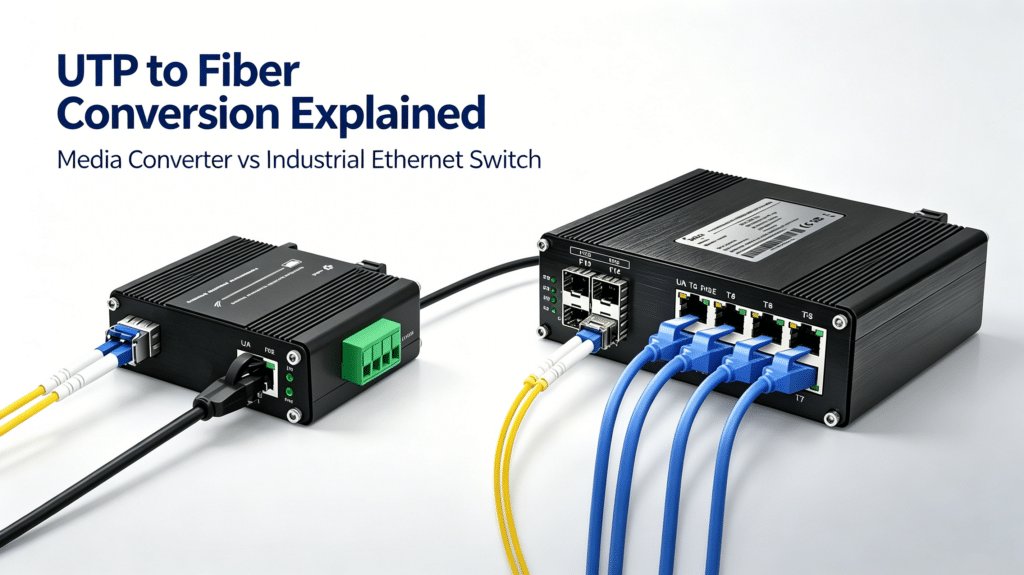
UTP to fiber conversion solution showing industrial media converter and Ethernet switch with SFP ports

UTP to Fiber Conversion Explained: Media Converter vs Industrial Ethernet Switch

In industrial and enterprise networks, ensuring stable and long-distance data transmission is a key requirement for reliable system performance. However, traditional Ethernet cabling (UTP) is limited to 100 meters and is highly vulnerable to electromagnetic interference, especially in industrial environments such as factories, power plants, transportation systems, and outdoor installations. As network systems expand, these

UTP to Fiber Conversion Explained: Media Converter vs Industrial Ethernet Switch Read More »

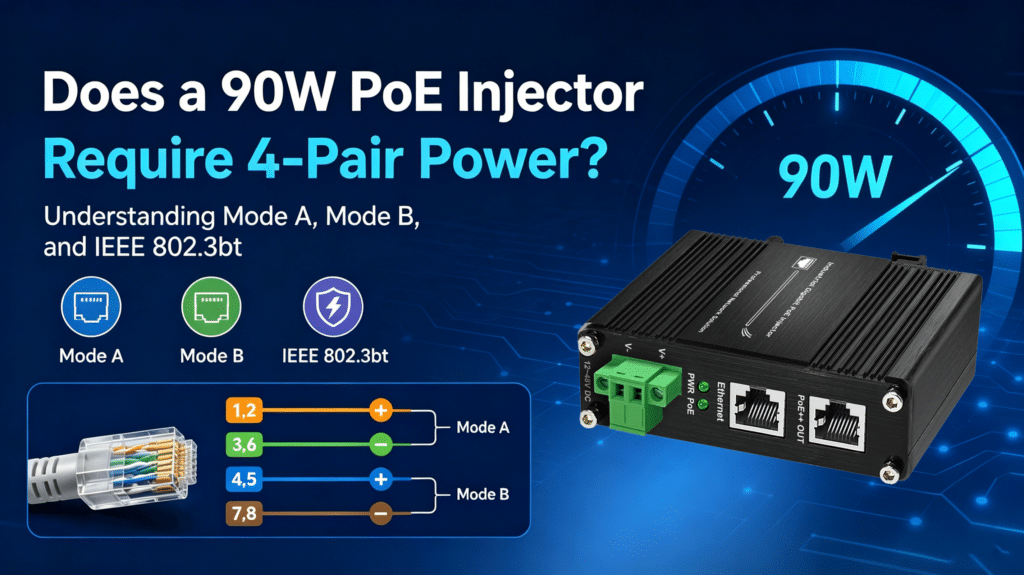
90W PoE Injector using 4-pair power delivery according to IEEE 802.3bt standard with Mode A and Mode B power pairs

Does a 90W PoE Injector Require 4-Pair Power? Understanding Mode A, Mode B, and IEEE 802.3bt

4-Pair Power Power over Ethernet (PoE) has become the preferred method for powering IP cameras, wireless access points, VoIP phones, industrial devices, and IoT equipment through a single Ethernet cable. However, many engineers and system integrators still ask an important question: Can a 90W PoE injector provide power over only two twisted pairs (2TWP), or

Does a 90W PoE Injector Require 4-Pair Power? Understanding Mode A, Mode B, and IEEE 802.3bt Read More »

Pluggable terminal block connector structure showing removable plug and fixed header used in industrial power and Ethernet switch applications

What Is a Terminal Block Connector? Industrial Guide for Power & Network Equipment

What Is a Terminal Block Connector? Industrial Guide for Power & Network Equipment Introduction A terminal block connector is one of the most widely used electrical connection solutions in industrial equipment such as industrial Ethernet switches, UPS systems, power supplies, and communication devices. Compared with traditional wiring methods, the terminal block connector provides a safer,

What Is a Terminal Block Connector? Industrial Guide for Power & Network Equipment Read More »

PoE vs PoE+ vs PoE++ switch comparison for IP cameras, WiFi access points, and industrial networks

PoE vs PoE+ vs PoE++ Switch: What’s the Difference and How to Choose?

PoE vs PoE+ vs PoE++ Introduction Power over Ethernet (PoE) technology allows network devices to transmit both power and data through a single Ethernet cable, simplifying installation and reducing deployment costs. From VoIP phones and IP cameras to WiFi 6 access points and industrial IoT equipment, PoE switches have become an essential part of modern

PoE vs PoE+ vs PoE++ Switch: What’s the Difference and How to Choose? Read More »

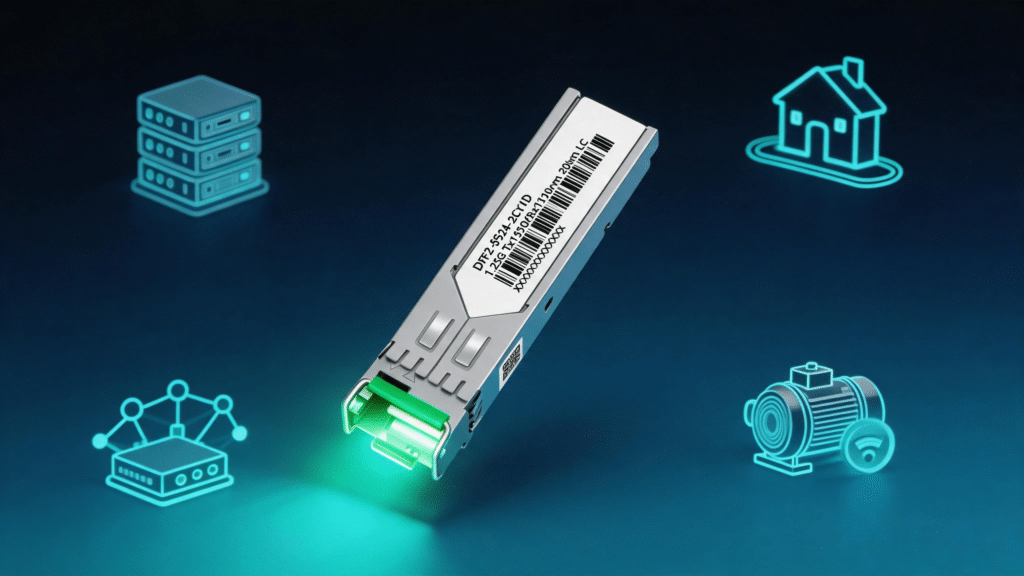
SFP Transceiver Modules with fiber connector, representing enterprise network, data center, FTTH and industrial Ethernet applications

What Are SFP Transceiver Modules? A Complete Guide to 1G and 10G Fiber Optic Transceivers

What Are SFP Transceiver Modules? SFP transceiver modules are compact, hot-pluggable optical modules used to transmit data over fiber optic networks. They are commonly installed in switches, routers, media converters, and other networking equipment to provide reliable high-speed fiber connectivity. SFP modules support a wide range of networking applications, from Gigabit Ethernet enterprise networks to

What Are SFP Transceiver Modules? A Complete Guide to 1G and 10G Fiber Optic Transceivers Read More »

802.3af vs 802.3at vs 802.3bt: What’s the Difference

802.3af vs 802.3at vs 802.3bt: What’s the Difference

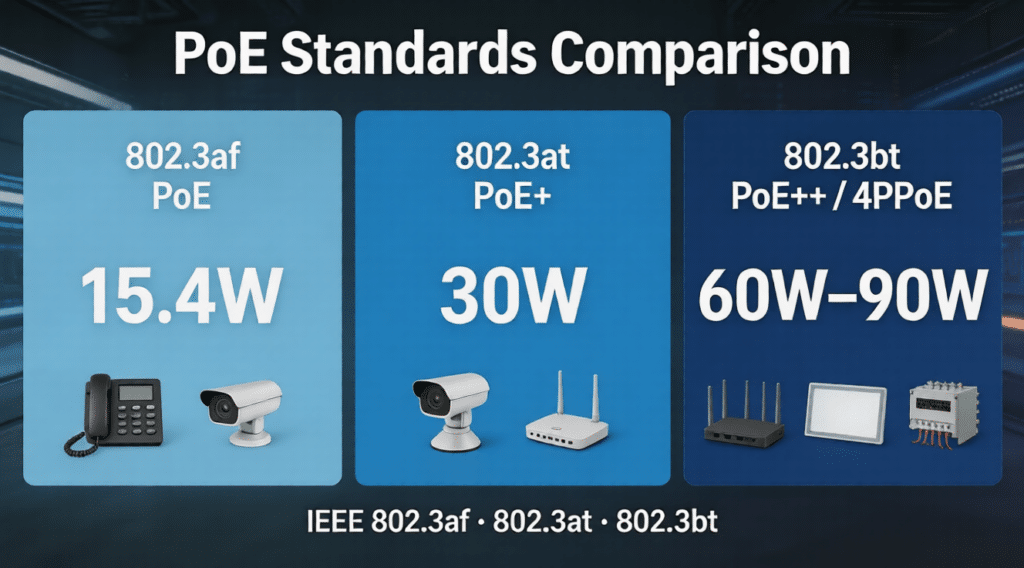
What Are PoE Standards Power over Ethernet (PoE) allows both data and DC power to be transmitted over a single Ethernet cable. This simplifies deployment in IP-based networks by removing the need for separate power wiring. The three commonly used IEEE PoE standards are: 802.3af (PoE) 802.3at (PoE+) 802.3bt (PoE++ / 4PPoE) The key difference

802.3af vs 802.3at vs 802.3bt: What’s the Difference Read More »