
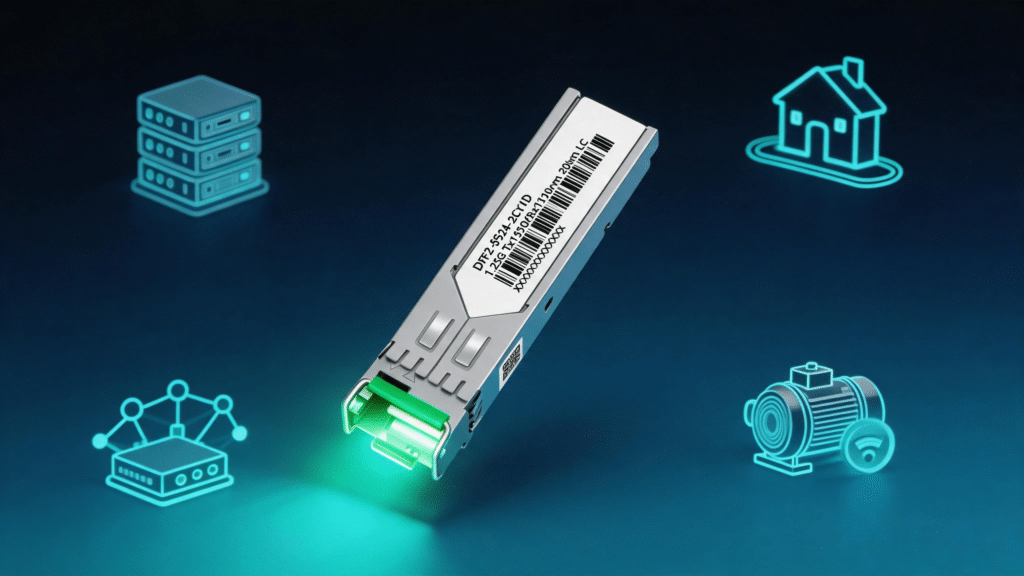
What Are SFP Transceiver Modules?
SFP transceiver modules are compact, hot-pluggable optical modules used to transmit data over fiber optic networks. They are commonly installed in switches, routers, media converters, and other networking equipment to provide reliable high-speed fiber connectivity.
SFP modules support a wide range of networking applications, from Gigabit Ethernet enterprise networks to high-speed 10G data center infrastructure.
Today, SFP and SFP+ transceivers are widely used in:
- Enterprise networks
- Telecom systems
- Data centers
- FTTH and ISP fiber networks
- Industrial Ethernet applications
Because different network environments require different transmission distances and fiber types, SFP modules are available in multiple configurations, including multimode, single-mode, BiDi single fiber, and duplex fiber solutions.
SFP vs SFP+: What’s the Difference?
One of the most common questions is the difference between SFP and SFP+ modules.
SFP Modules
Standard SFP modules typically support data rates up to 1.25Gbps and are commonly used for Gigabit Ethernet applications.
Typical examples include:
- 1G multimode SFP modules
- 1G single-mode SFP transceivers
- 1G BiDi optical modules
SFP+ Modules
SFP+ modules are designed for 10Gbps transmission and are commonly used in high-speed enterprise and data center networks.
Typical examples include:
- 10G SFP+ SR modules
- 10G SFP+ LR transceivers
In general:
- SFP = 1G
- SFP+ = 10G
Single Mode vs Multi Mode SFP Modules
Choosing between single-mode and multimode fiber transceivers depends mainly on transmission distance and network requirements.
Multi Mode SFP Modules
Multi mode SFP modules are optimized for short-distance transmission over MMF (multimode fiber). They typically operate at 850nm wavelengths and are widely used in local area networks and data centers.
Advantages of MMF SFP Modules
- Cost-effective for short distances
- Suitable for high-density cabling
- Lower deployment cost
- Commonly used in data centers
Typical Transmission Distances
- 300m for 10G SFP+ SR modules
- 550m for 1G SFP modules
Typical products include:
Single Mode SFP Modules
Single-mode SFP modules are designed for long-distance communication over SMF (single-mode fiber). These modules commonly operate at 1310nm wavelengths and support stable long-range optical transmission.
Advantages of SMF SFP Modules
- Long-distance communication
- Stable optical performance
- Suitable for backbone networks
- Ideal for telecom and ISP infrastructure
Typical Transmission Distances
- 3km
- 10km
- 20km and beyond
Typical products include:

What Is a BiDi SFP Module?
BiDi SFP modules allow bidirectional communication over a single optical fiber strand instead of two fibers.
Unlike traditional duplex fiber modules, BiDi transceivers use different wavelengths for transmitting and receiving data, such as:
- Tx1310nm / Rx1550nm
- Tx1550nm / Rx1310nm
This design helps reduce fiber cabling requirements and lowers deployment costs.
Advantages of BiDi SFP Modules
- Saves fiber resources
- Reduces cabling cost
- Simplifies deployment
- Ideal for FTTH and access networks
BiDi SFP modules are commonly used in:
- FTTH systems
- Enterprise access networks
- Industrial fiber communication
- ISP fiber infrastructure

LC vs SC Fiber Connectors
Optical networking devices are available with different connector interfaces, with LC and SC being the most commonly used types.
LC Connector
- Compact form factor
- Suitable for high-density applications
- Commonly used in switches and data centers
SC Connector
- Larger connector size
- Easy installation and maintenance
- Common in telecom and industrial environments

Common Applications for Fiber Optic Networking
Modern optical communication products are widely used across multiple industries.
Enterprise Networks
Used for fiber uplinks, switch aggregation, and backbone communication.
Data Centers
Enable high-speed connectivity between servers, storage devices, and switching equipment.
Telecom Infrastructure
Support stable long-distance optical transmission for carrier networks.
FTTH and Broadband Systems
Provide reliable fiber access for residential and commercial deployments.
Industrial Ethernet
Support stable communication in industrial and outdoor environments.
How to Choose the Right Optical Transceiver
Before selecting a fiber optic networking solution, consider the following factors:
Transmission Speed
- Gigabit Ethernet
- 10G Ethernet
Fiber Type
- Multimode fiber (MMF)
- Single-mode fiber (SMF)
Transmission Distance
- 300m
- 550m
- 3km
- 20km
Connector Type
- Duplex LC
- Simplex SC
Network Environment
- Data center
- Enterprise network
- Telecom backbone
- FTTH infrastructure
Conclusion
Fiber optic transceivers play an important role in modern network infrastructure by providing reliable and scalable optical communication solutions.
From short-range multimode connectivity in data centers to long-distance single-mode transmission for telecom and enterprise backbone systems, choosing the right optical networking device helps improve network stability, flexibility, and performance.
Understanding the differences between 1G and 10G optical technologies, multimode and single-mode fiber solutions, and BiDi transmission can help simplify deployment and improve overall network efficiency.