

4-Pair Power
Power over Ethernet (PoE) has become the preferred method for powering IP cameras, wireless access points, VoIP phones, industrial devices, and IoT equipment through a single Ethernet cable. However, many engineers and system integrators still ask an important question:
Can a 90W PoE injector provide power over only two twisted pairs (2TWP), or does it require all four pairs?
The answer depends on the PoE standard and power level being used.
Understanding PoE Power Modes
Traditional Ethernet cables contain four twisted wire pairs (eight conductors). Different PoE standards use these pairs differently for power transmission.
Mode A
Mode A delivers power over the same wire pairs used for data transmission:
- Pins 1,2 = Positive (+)
- Pins 3,6 = Negative (-)
This method is commonly used in 10/100 Mbps Ethernet networks.
Mode B
Mode B uses the spare pairs for power delivery:
- Pins 4,5 = Positive (+)
- Pins 7,8 = Negative (-)
Historically, Mode B was common in early PoE implementations where spare pairs were available.

What Is 2-Pair PoE?
2-Pair PoE uses only two twisted pairs to carry power.
This approach is sufficient for:
| Standard | Maximum Power |
|---|---|
| IEEE 802.3af | 15.4W |
| IEEE 802.3at | 30W |
| IEEE 802.3bt Type 3 | Up to 60W |
For low and medium power devices such as IP phones, basic surveillance cameras, and standard wireless access points, 2-pair power delivery is generally adequate.

Why 90W PoE Requires 4 Pairs
As power requirements increase, transmitting all current through only two pairs becomes inefficient.
Higher current levels result in:
- Increased cable heating
- Higher power loss
- Reduced transmission efficiency
- Greater stress on connectors and conductors
To solve these challenges, IEEE introduced 4-pair power delivery in the IEEE 802.3bt standard.
A typical 90W PoE injector distributes power across all four twisted pairs:
- Pins 1,2 (+)
- Pins 3,6 (-)
- Pins 4,5 (+)
- Pins 7,8 (-)
This configuration is commonly referred to as 4-Pair PoE or 4PPoE.

IEEE 802.3bt and 90W Power Delivery
IEEE 802.3bt significantly increased PoE power capabilities compared to earlier standards.
IEEE 802.3bt Type 4
Key characteristics include:
- Maximum PSE output: 90W to 100W
- Up to 71W delivered to the powered device
- 4-pair power transmission
- Support for high-power applications
Examples include:
- PTZ security cameras
- Multi-radio Wi-Fi access points
- LED lighting systems
- Digital signage
- Industrial automation equipment
- Thin-client workstations
Because of the high power requirements, full 90W operation relies on all four cable pairs simultaneously.
Is a 90W Injector Mode A or Mode B?
This is where confusion often occurs.
Many users assume a PoE injector must be either Mode A or Mode B.
For modern IEEE 802.3bt injectors, the reality is different.
A 90W injector typically powers:
- Mode A pairs (1,2 and 3,6)
- Mode B pairs (4,5 and 7,8)
at the same time.
Therefore, a 90W injector is not a Mode A-only solution nor a Mode B-only solution. It uses both sets of pairs simultaneously to achieve high-power delivery.
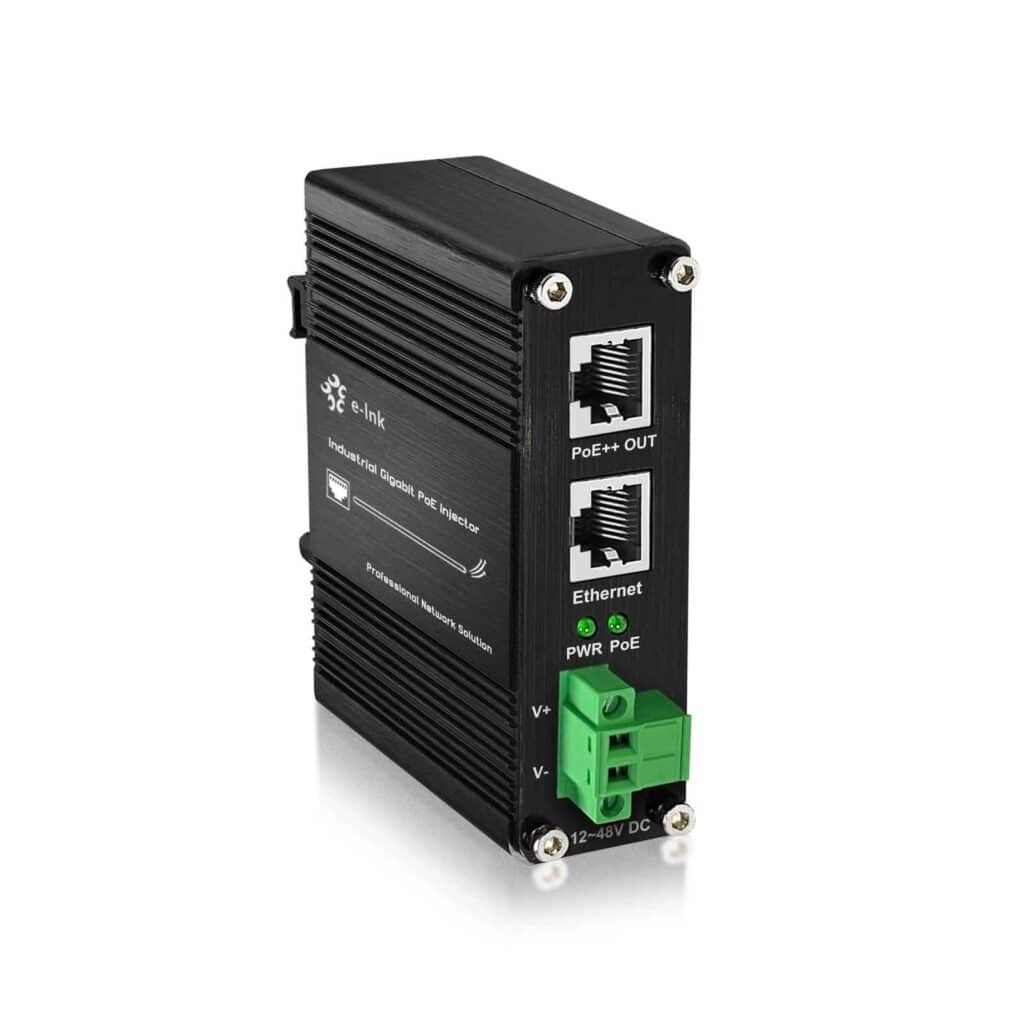
Can 90W PoE Work Over a 2-Twisted-Pair Connection?
In general, no.
A standard IEEE 802.3bt 90W injector requires all four twisted pairs to deliver its rated power output.
If only two pairs are available:
- Full 90W power cannot be delivered
- Device startup may fail
- Power negotiation may be limited
- System reliability may be reduced
For applications requiring the full capability of a 90W PoE injector, Cat5e, Cat6, or higher cabling with all four pairs connected is strongly recommended.
Conclusion
While lower-power PoE standards can operate using only two twisted pairs, a true 90W IEEE 802.3bt PoE injector relies on 4-pair power delivery.
By distributing current across all four pairs, 802.3bt achieves higher efficiency, lower cable heating, and reliable support for today’s high-power network devices.
When selecting a PoE injector, always verify:
- PoE standard
- Power budget
- Pair configuration
- Cabling quality
Understanding the difference between Mode A, Mode B, and 4-pair PoE helps ensure reliable deployment and maximum performance from your network infrastructure.