

What Are PoE Standards
Power over Ethernet (PoE) allows both data and DC power to be transmitted over a single Ethernet cable. This simplifies deployment in IP-based networks by removing the need for separate power wiring.
The three commonly used IEEE PoE standards are:
- 802.3af (PoE)
- 802.3at (PoE+)
- 802.3bt (PoE++ / 4PPoE)
The key difference between them is the amount of power that can be delivered to the powered device (PD), not just the maximum output at the switch (PSE).
802.3af vs 802.3at vs 802.3bt Comparison
| Standard | Max Power (PSE) | Power at PD | Voltage | Cable Pairs | Typical Devices |
|---|---|---|---|---|---|
| 802.3af | 15.4W | ~12.95W | 44–57V | 2 pairs | VoIP, basic IP cameras |
| 802.3at | 30W | ~25.5W | 50–57V | 2 pairs | PTZ cameras, APs |
| 802.3bt | 60–90W | ~51–71W | 50–57V | 4 pairs | High-power devices |
Note: The actual power available at the device is lower due to cable loss.
802.3af (PoE)
802.3af is the first-generation PoE standard and is intended for low-power devices.
Key characteristics
- Up to 15.4W per port (PSE)
- ~12.95W available at device
- Power delivered over 2 pairs
Typical use cases
- VoIP phones
- Entry-level IP cameras
- Low-power sensors
This standard is suitable where power demand is stable and relatively low.
802.3at (PoE+)
802.3at increases the available power and improves device compatibility.
Key characteristics
- Up to 30W per port
- ~25.5W available at PD
- Backward compatible with 802.3af
Typical use cases
- PTZ cameras
- Wireless access points
- Industrial network devices
In most real deployments, 802.3at provides sufficient power while maintaining reasonable system cost.
802.3at (PoE+)
802.3bt is designed for higher power requirements and introduces 4-pair power delivery.
Key characteristics
- Type 3: up to 60W
- Type 4: up to 90W
- Uses all 4 twisted pairs
- Backward compatible with af and at
Typical use cases
- High-performance wireless APs
- LED lighting systems
- Video conferencing equipment
- Industrial terminals
When device power exceeds ~25–30W, this standard becomes necessary.
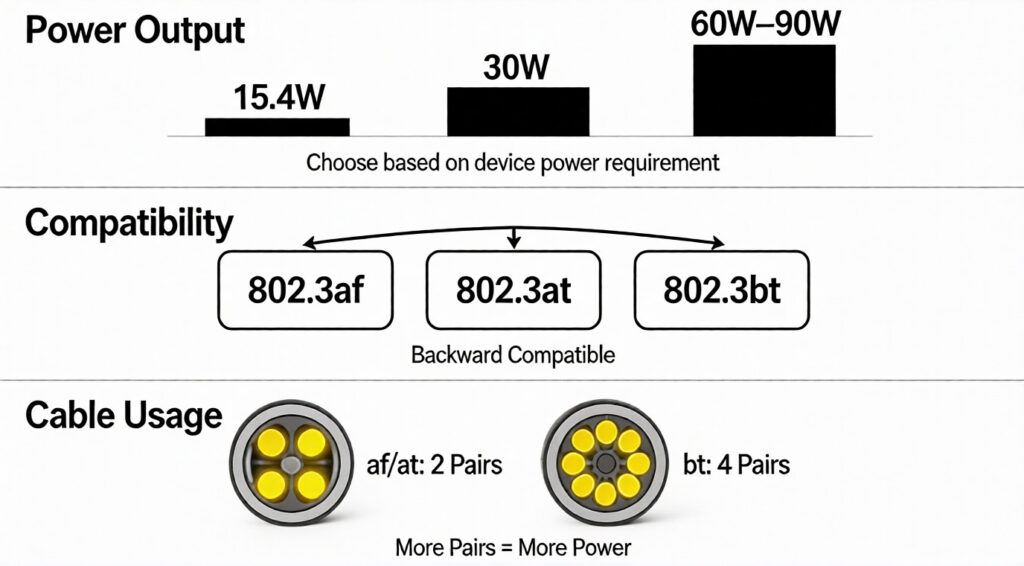
Key Technical Differences
Power delivery
802.3af and 802.3at use 2 pairs, while 802.3bt uses all 4 pairs. This increases total power capacity and reduces current load per conductor.
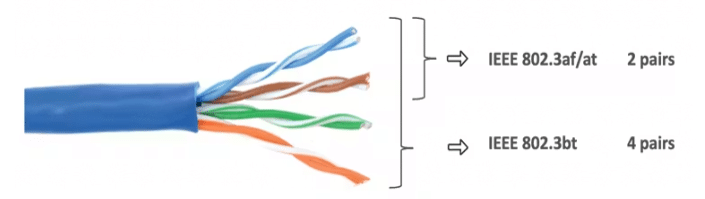
Cable utilization
More pairs allow better thermal distribution and higher efficiency, especially under continuous load.
Compatibility
Higher standards automatically support lower ones through power negotiation. This allows mixed device environments without manual configuration.
PoE Budget Consideration
In practice, total PoE budget is often more important than per-port power.
Example:
- 24-port PoE+ switch
- 30W per port
- Total budget: 400W
It is not possible to run 24 devices at 30W simultaneously.
When designing a system, total device consumption should always be compared against the available PoE budget.
How to Choose the Right PoE Standard
A simple engineering approach:
Step 1 — Check device power
- < 13W → 802.3af
- 13–25W → 802.3at
- 25W → 802.3bt
Step 2 — Add margin
Include 20–30% headroom to account for startup current and cable loss.
Step 3 — Verify total budget
Ensure total load does not exceed switch capacity.

Example Scenario
A system includes:
- 8 IP cameras
- Each consumes 25W
Total load = 200W
With margin, recommended budget ≥ 240W
In this case, an 802.3at PoE+ switch is appropriate. A lower standard may lead to instability during peak load.
Common Issues in Deployment
- Selecting switches based only on port count
- Ignoring total PoE budget
- Assuming full rated power reaches the device
- Mixing passive PoE (24V) with IEEE PoE
- Not accounting for startup power spikes
Conclusion
The differences between 802.3af, 802.3at, and 802.3bt are mainly defined by power capacity, cable usage, and application scope.
802.3af is suitable for low-power devices.
802.3at covers most standard deployments.
802.3bt is required for high-power applications.
Accurate power estimation and proper budget planning are essential for stable PoE system operation.