
Passive PoE vs Active PoE: Voltage, Safety and Compatibility Guide

Power over Ethernet (PoE) technology allows both power and data transmission through a single Ethernet cable, reducing installation complexity and improving network deployment efficiency. PoE is widely used in IP cameras, wireless access points, VoIP phones, industrial Ethernet devices, and outdoor wireless systems.
When selecting PoE equipment, one of the most common questions is the difference between Passive PoE and Active PoE.
Although both technologies deliver power through Ethernet cables, they work in completely different ways. The main differences are power negotiation, voltage control, device protection, and compatibility.
Understanding the difference between passive PoE and active PoE helps users choose the right PoE switch, PoE injector, or industrial PoE solution while avoiding compatibility issues and potential device damage.
What Is Active PoE?
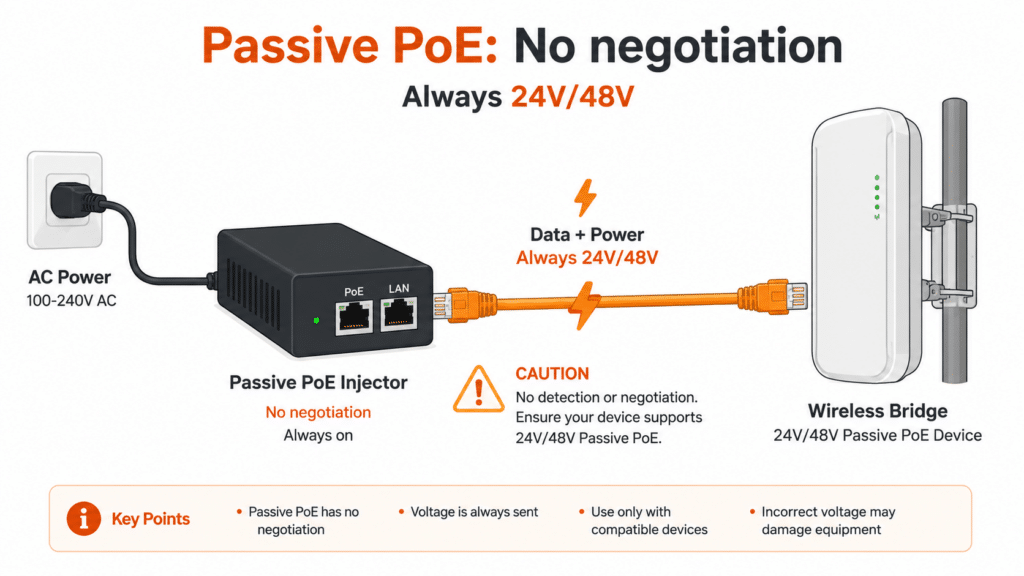
Passive PoE is a non-standard PoE technology that delivers a fixed voltage through an Ethernet cable without communication between the power source and the connected device.
Unlike IEEE-standard PoE, passive PoE does not perform device detection before supplying power. Once the PoE injector or switch is powered on, voltage is continuously transmitted through the Ethernet cable regardless of whether the connected device supports PoE.
Common passive PoE voltages include 12V, 24V, and 48V. Among them, 24V passive PoE is widely used in outdoor wireless networking equipment such as wireless bridges, CPE devices, and point-to-point wireless systems.
The main advantages of passive PoE are its simple design and lower cost. However, because it does not provide automatic power negotiation, users must confirm the voltage requirements and pin configuration of the connected device before installation.
Common Features of Active PoE
- Automatic device detection
- IEEE standard compliance
- Intelligent power negotiation
- Better device protection
- Broad compatibility with modern network equipment
Typical Active PoE Devices
- PoE switches
- PoE injectors
- IP cameras
- Wireless access points
- VoIP phones
- Industrial Ethernet equipment
What Is Passive PoE?
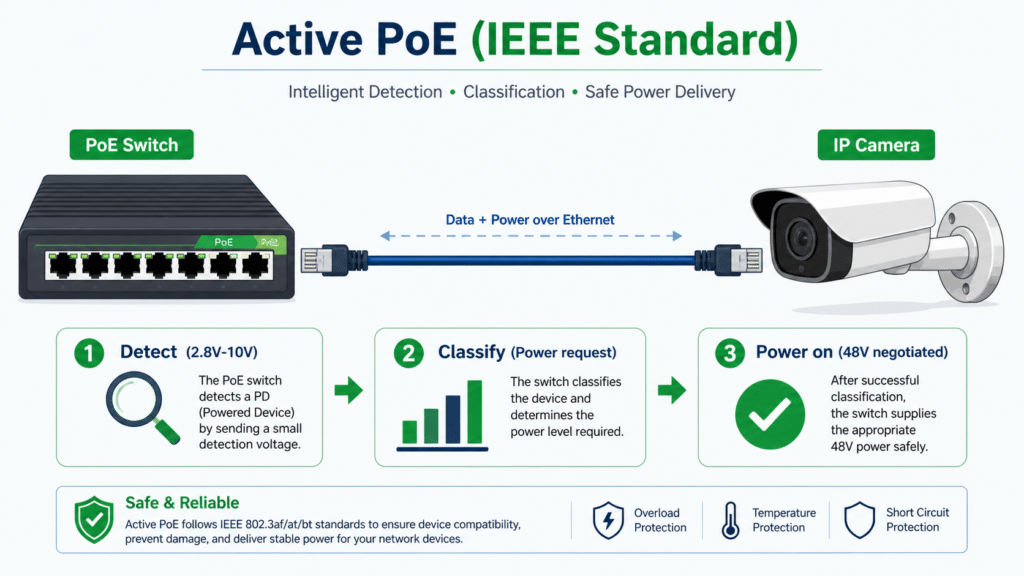
Active PoE is based on IEEE PoE standards, including IEEE 802.3af, IEEE 802.3at, and IEEE 802.3bt. These standards define how PoE devices detect, classify, and deliver power safely over Ethernet cables.
Before supplying power, an active PoE switch or PoE injector communicates with the connected device to verify whether it supports PoE and determine the required power level. Power is only delivered after successful detection.
This negotiation process provides better equipment protection and wider compatibility, making active PoE the preferred solution for enterprise and industrial applications.
Common active PoE applications include IP cameras, WiFi access points, VoIP phones, industrial Ethernet equipment, and smart building systems.
Common Features of Active PoE
- No power negotiation
- Fixed voltage output
- Simpler hardware structure
- Lower deployment cost
- Typically non-standard PoE
Typical Passive PoE Applications
- Outdoor wireless bridges
- CPE devices
- Point-to-point wireless systems
- Passive PoE injectors
- Certain wireless access devices
- Legacy wireless equipment
Passive PoE is especially common in low-cost PoE injectors and outdoor wireless deployments where the connected devices are designed for a specific input voltage.
Passive PoE vs Active PoE: Key Differences
The biggest difference between passive PoE and active PoE is the way power is delivered.
| Feature | Active PoE | Passive PoE |
|---|---|---|
| Standard | IEEE 802.3af/at/bt | Usually non-standard |
| Power Detection | Yes | No |
| Voltage Control | Automatic negotiation | Fixed voltage output |
| Device Protection | High | Limited |
| Compatibility | Wide | Device-specific |
| Common Voltage | 48V | 12V / 24V / 48V |
| Cost | Higher | Lower |
Active PoE automatically checks device compatibility before power delivery, while passive PoE sends a fixed voltage immediately. Therefore, active PoE is generally safer for mixed network environments, while passive PoE is suitable for dedicated systems with known power requirements.
Does Passive PoE Damage Devices?
Passive PoE does not damage devices when used with compatible equipment. The risk comes from incorrect voltage or incompatible connections.
Because passive PoE does not perform power negotiation, it cannot determine whether the connected device accepts the supplied voltage. For example, connecting a 24V passive PoE injector to a device designed for standard 48V IEEE PoE may cause malfunction or hardware damage.
Before using passive PoE equipment, users should always verify:
- Required input voltage
- PoE pin configuration
- Maximum power consumption
- Device PoE compatibility
For large-scale networks where different types of equipment are connected, active PoE is usually recommended because it provides automatic protection.
Why Does 24V Passive PoE Exist?
Many users wonder why 24V passive PoE is still widely used when modern IEEE PoE standards typically operate around 48V.
The main reason is that many outdoor wireless networking devices were designed around 24V power systems. Wireless CPE devices, outdoor bridges, and point-to-point wireless equipment often use 24V passive PoE because it provides a simple and cost-effective power solution.
Compared with active PoE, passive PoE equipment requires fewer components because it does not need detection and classification circuits. This makes it more affordable for specific applications.
However, 24V passive PoE should only be used with devices specifically designed for 24V input.
24V Passive PoE vs 48V Active PoE
One of the most common PoE compatibility questions is the difference between 24V passive PoE and 48V active PoE.
| Feature | 24V Passive PoE | 48V Active PoE |
|---|---|---|
| Voltage | Fixed 24V | Around 48V with negotiation |
| Standard | Usually non-IEEE | IEEE 802.3 compliant |
| Detection | No | Yes |
| Protection | Limited | Better protection |
| Applications | Wireless CPE, outdoor bridges | Cameras, APs, enterprise networks |
24V passive PoE is commonly found in outdoor wireless systems where the connected device requires a specific voltage input. In comparison, 48V active PoE is widely used in enterprise and industrial networks because it supports automatic detection and better compatibility.
For modern network deployments, 48V active PoE is usually the recommended choice unless the device specifically requires passive PoE.
Can Passive PoE Work With IEEE PoE?
Passive PoE and IEEE PoE are generally not directly compatible.
An IEEE PoE switch uses a detection process before supplying power, while passive PoE devices expect a fixed voltage input. As a result, an IEEE PoE switch may not power a passive PoE device, and a passive PoE injector may damage equipment that does not support the supplied voltage.
When integrating passive PoE and active PoE devices in the same network, users may need a compatible PoE converter or adapter.
Always confirm the PoE standard, voltage requirements, and power specifications before deployment.
How to Choose the Right PoE Solution?
The correct PoE solution depends on the connected equipment and the deployment environment.
Active PoE is commonly recommended for:
- Enterprise networks
- Industrial Ethernet systems
- IP surveillance projects
- Standard IEEE PoE devices
- Multi-device installations
Passive PoE is commonly used for:
- Outdoor wireless bridges
- 24V networking equipment
- Wireless CPE deployments
- Point-to-point wireless systems
- Cost-sensitive installations
Before deployment, always confirm that the PoE switch, injector, and powered device use compatible voltage and pin assignments.

Conclusion
Passive PoE and Active PoE serve different networking requirements. Active PoE provides automatic detection, IEEE standard compliance, and improved device protection, making it ideal for enterprise and industrial networks.
Passive PoE offers a simpler and more affordable solution for specific applications, especially 24V outdoor wireless deployments.
Before choosing a PoE switch or PoE injector, always check the device voltage requirements, PoE standard, and compatibility to ensure safe and reliable operation.
FAQ
Is passive PoE the same as standard PoE?
No. Standard PoE usually refers to IEEE 802.3af/at/bt active PoE, while passive PoE does not use IEEE power negotiation.
Is 24V PoE active or passive?
Most 24V PoE systems are passive PoE because IEEE PoE standards typically operate around 48V.
Can passive PoE damage Ethernet devices?
Yes. If the voltage or pin configuration is incorrect, passive PoE may damage incompatible devices.
Is active PoE better than passive PoE?
Active PoE provides better protection and compatibility, while passive PoE is useful for specific low-cost applications such as outdoor wireless networking.