
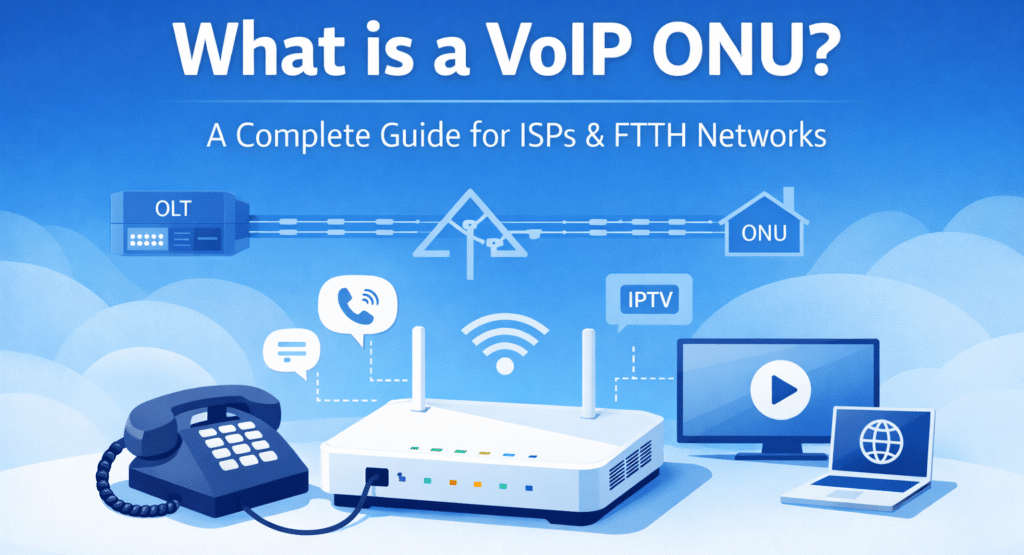
As FTTH (Fiber to the Home) networks mature, the role of the ONU (Optical Network Unit) has evolved from a simple optical termination point into a multi-service access gateway.
Modern subscribers no longer require just internet access — they expect a fully integrated service stack including:
- High-speed broadband
- Wireless connectivity
- Carrier-grade voice services
To meet these demands, ISPs increasingly deploy VoIP ONUs, which combine optical access with IP-based voice capabilities in a single device.
This article explains, from an engineering perspective, what a VoIP ONU is, how it works within a PON architecture, and why it is critical for modern FTTH deployments.
1. From Traditional ONU to VoIP ONU
In a standard FTTH setup, a conventional ONU provides:
- Fiber termination (GPON / EPON)
- Ethernet connectivity
- Basic routing and NAT functions
However, delivering voice services traditionally required separate VoIP gateways (ATA devices).
A VoIP ONU eliminates this separation.
Definition
A VoIP ONU (Voice over IP Optical Network Unit) is an integrated customer-premises device that combines:
- Optical network termination (XPON)
- Layer 3 routing (NAT, DHCP, PPPoE)
- Wireless access (WiFi5 / WiFi6)
- Voice interface (FXS port / RJ11)
👉 In essence, it merges three devices into one: ONU + Router + VoIP gateway.
This integration is what enables efficient triple-play service delivery (Internet + Voice + IPTV).
2. Where VoIP ONU Fits in FTTH Architecture
To understand its role, we need to look at the Passive Optical Network (PON) structure. A typical FTTH network consists of:
- OLT (Optical Line Terminal) at the central office
- ODN (Optical Distribution Network) with fiber and splitters
- ONU at the user premises
The VoIP ONU is deployed at the subscriber side, acting as the service demarcation point. It performs two critical functions simultaneously:
- Converts optical signals into Ethernet/IP traffic
- Processes voice communication at the edge
👉 This makes the ONU not just a receiver, but an active service processing node.
3. How a VoIP ONU Works (Signal Flow Explained)
From an engineering perspective, the VoIP function inside an ONU is a real-time signal processing pipeline.
Voice Processing Workflow
- Step 1 — Analog Input (FXS Interface)
A traditional telephone generates an analog voice signal via the RJ11 port. - Step 2 — Analog-to-Digital Conversion (ADC)
The ONU converts analog signals into digital data using DSP modules. - Step 3 — Voice Encoding (Codec Layer)
The signal is compressed using standard codecs:G.711(high quality),G.729(low bandwidth),G.722(HD voice). - Step 4 — Packetization & Signaling
Voice data is encapsulated into IP packets:SIPhandles call control,RTPcarries media streams. - Step 5 — Transmission over PON
Packets are sent upstream via the PON network to the OLT, sharing bandwidth with data traffic. - Step 6 — Core Network Processing
At the operator side, calls are handled by Softswitch systems or IMS (IP Multimedia Subsystem).
👉 This pipeline enables traditional telephony over packet-switched fiber networks.
4. Key Features That Define a VoIP ONU
From a deployment standpoint, a VoIP ONU is defined by several essential capabilities:
- Low latency
- Minimal jitter
- Stable call quality
- Internet access
- Voice communication
- IPTV services
5. VoIP ONU vs Standard ONU (Engineering Perspective)
The difference is not just “voice or no voice” — it’s about network architecture simplification.
| Feature | Standard ONU | VoIP ONU |
|---|---|---|
| Internet Access | ✔ | ✔ |
| WiFi | ✔ | ✔ |
| VoIP Interface (RJ11) | ✖ | ✔ |
| Voice Processing | ✖ | ✔ |
| Triple-play Support | Limited | Full |
👉 A VoIP ONU moves voice processing from the core network edge to the user edge.
6. Why ISPs Deploy VoIP ONUs
From an ISP engineering and operations perspective, VoIP ONUs provide clear advantages:
- Simplified Network Architecture — No need for separate VoIP gateway hardware.
- Lower Deployment Cost — Fewer devices → reduced CAPEX and maintenance cost.
- Unified Device Management — All services can be managed via
TR069orOMCI. - Improved Reliability — Fewer physical connections → fewer failure points.
- Seamless Migration to All-IP Networks — Supports the transition away from legacy PSTN infrastructure.
7. Real-World Deployment Scenarios
VoIP ONUs are widely used in:
- Residential FTTH broadband
- ISP triple-play services
- Hospitality networks (hotels, MDUs)
- Small business communication systems
- Rural broadband deployments
8. How to Choose the Right VoIP ONU
For ISPs and network engineers, selection should be based on:
- Network Compatibility — GPON / EPON / XPON support.
- Wireless Performance — WiFi5 (AC1200) → entry-level / WiFi6 (AX3000) → high-density environments
- Voice Capability — SIP compatibility, codec support, RJ11 (FXS) ports.
- Hardware Interfaces — GE ports, USB support, VLAN / QoS features.
9. Future Trends: VoIP ONU + WiFi6
FTTH networks are evolving toward:
- Gigabit and multi-gigabit bandwidth
- High-density device environments
- Smart home ecosystems
- Cloud-managed CPE
In this context, WiFi6 VoIP ONUs are becoming the standard choice, combining high wireless efficiency, integrated voice services, and future-proof scalability. For deployments requiring superior wireless density and multi-gigabit speeds, WiFi6 (AX3000) models deliver outstanding performance.
Conclusion
A VoIP ONU is no longer just a fiber access device — it is a multi-service edge gateway that enables ISPs to deliver complete digital services over a single infrastructure.
By integrating voice, data, and wireless capabilities, it:
- Simplifies deployment
- Reduces operational cost
- Enhances user experience
For ISPs building or upgrading FTTH networks, deploying WiFi6 VoIP ONUs is a strategic move toward scalable, all-IP service delivery. Entry-level deployments benefit from mature and cost-effective WiFi5 (AC1200) ONUs, while high-density scenarios are best served by next-generation WiFi6 hardware.
Engineering summary: The VoIP ONU integrates FXS, SIP stack, advanced QoS and PON MAC into a single SoC architecture, drastically reducing CPE sprawl while maintaining carrier-grade voice SLAs. Ideal for ISPs targeting convergence and operational excellence.