

In industrial and enterprise networks, ensuring stable and long-distance data transmission is a key requirement for reliable system performance. However, traditional Ethernet cabling (UTP) is limited to 100 meters and is highly vulnerable to electromagnetic interference, especially in industrial environments such as factories, power plants, transportation systems, and outdoor installations.
As network systems expand, these limitations often lead to communication instability and distance restrictions, making fiber optic transmission a necessary upgrade for modern infrastructure.
To solve this, UTP to fiber conversion is widely used to extend Ethernet networks while maintaining stable and interference-free communication.
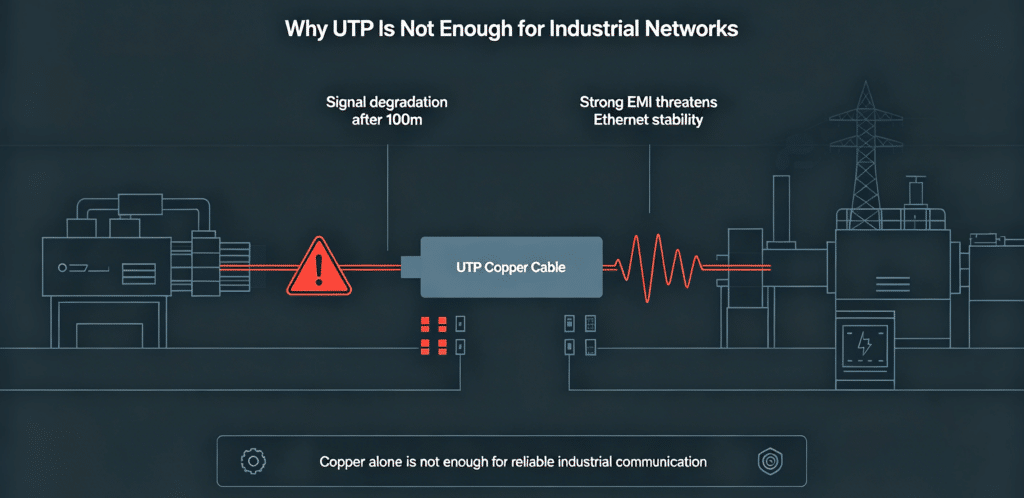
Why UTP Is Not Enough for Industrial Networks
Although UTP cables such as Cat5e and Cat6 are widely used due to their low cost and simple installation, they have inherent limitations that make them unsuitable for many industrial applications.
The most critical limitation is transmission distance. Once the cable exceeds 100 meters, signal degradation occurs, resulting in packet loss or complete communication failure. In addition, industrial environments often contain heavy machinery and high-voltage equipment, which generate electromagnetic interference that can severely affect Ethernet stability.
As a result, many industrial systems cannot rely solely on copper-based Ethernet and require fiber optic transmission to ensure stable and long-distance communication.
Two Practical Solutions
In real industrial applications, there are two main solutions used for UTP to fiber conversion. The right choice depends on whether you need a simple point-to-point connection or a complete network system.
Solution 1: Industrial Media Converter
An Industrial Media Converter is a dedicated device designed to convert RJ45 Ethernet signals into fiber optic signals. It is the simplest and most direct solution for extending a single Ethernet link over long distances.
Because it is plug-and-play and does not require configuration, it is widely used in applications where simplicity and cost efficiency are the main priorities.
Typical applications include surveillance systems, remote device connections, and simple industrial communication extensions.
Explore product:
Industrial Media Converter | Ethernet to Fiber Conversion
✔ Best for:
- Point-to-point Ethernet extension
- Simple fiber link deployment
- Cost-sensitive projects

Solution 2: Industrial Ethernet Switch with SFP Port
For more complex network systems, an Industrial Ethernet Switch with SFP ports provides both switching and fiber connectivity in a single device. Unlike a media converter, it allows multiple devices to connect and communicate within the same network.
The SFP interface provides flexible fiber expansion options, allowing users to select different optical modules based on distance and fiber type requirements. This makes it suitable for industrial automation, smart infrastructure, and large-scale network deployments.
Explore product:
Industrial Unmanaged Switch | Reliable Network Connectivity
✔ Best for:
- Multi-device industrial networks
- Scalable system architecture
- Industrial automation and control systems

Media Converter vs Industrial Switch
| Feature | Media Converter | Industrial Ethernet Switch |
|---|---|---|
| Main Function | Simple Ethernet to fiber conversion | Network switching + fiber uplink |
| Network Type | Point-to-point connection | Multi-device network system |
| Complexity | Plug-and-play, no configuration | Requires network planning |
| Scalability | Limited | High scalability |
| Installation | Simple and fast | Suitable for structured networks |
| Cost | Lower cost | Higher investment |
| Best Use Case | Single link extension | Industrial automation & system networks |
How to Choose the Right Solution
If your project only requires extending a single Ethernet connection over fiber, a media converter is usually sufficient.
However, if your system involves multiple devices, future expansion, or centralized network management, an industrial Ethernet switch with SFP ports will provide better flexibility and scalability.
If you are still unsure, choosing the right solution depends on:
- Transmission distance
- Fiber type (single-mode or multi-mode)
- Number of connected devices
- Installation environment
Industrial Networking Solutions from E-link
At e-link.us, we provide complete industrial networking solutions designed for reliable communication in harsh and demanding environments.
Our product portfolio includes:
- Industrial Media Converters for simple Ethernet to fiber extension
- Industrial Ethernet Switches with SFP ports for scalable network systems
- PoE switches and industrial networking equipment for advanced applications
These solutions are engineered to ensure stable performance, long service life, and compatibility with industrial automation and communication systems.
Explore full product range: https://e-link.us/
Need Help Choosing the Right Solution?
If you are not sure which solution fits your project, our technical team can help you evaluate your requirements and recommend the most suitable and cost-effective option.
We support selection based on:
- Application scenario
- Transmission distance
- Fiber type
- Network structure
Contact us through e-link.us for professional technical support and quotation.
Conclusion
UTP to fiber conversion is a critical technology in modern industrial networking, enabling long-distance, stable, and interference-resistant communication.
Both Industrial Media Converters and Industrial Ethernet Switches with SFP ports provide effective solutions. The key is choosing the right one based on whether your project requires simple extension or a scalable network system.
With the right solution, you can significantly improve network stability, transmission distance, and system reliability.