

PoE vs PoE+ vs PoE++
Introduction
Power over Ethernet (PoE) technology allows network devices to transmit both power and data through a single Ethernet cable, simplifying installation and reducing deployment costs. From VoIP phones and IP cameras to WiFi 6 access points and industrial IoT equipment, PoE switches have become an essential part of modern networking infrastructure.
As network devices continue to demand higher power, PoE standards have evolved from PoE (IEEE 802.3af) to PoE+ (IEEE 802.3at) and PoE++ (IEEE 802.3bt). However, many users still struggle to understand the differences between PoE vs PoE+ vs PoE++ switches and which one is best for their applications.
In this guide, we will explain the differences between PoE, PoE+, and PoE++ switches, including power levels, standards, applications, compatibility, and how to choose the right PoE switch for your network.
What Is a PoE Switch?
A PoE switch, also known as a Power over Ethernet switch, is a network switch that can deliver both electrical power and network data over standard Ethernet cables.
Unlike traditional network deployments that require separate power supplies for devices, PoE technology simplifies cabling by using a single Ethernet cable for both functions. This reduces installation complexity, lowers infrastructure costs, and improves deployment flexibility.
A PoE switch functions as Power Sourcing Equipment (PSE), while connected devices such as IP cameras, wireless access points, or VoIP phones are known as Powered Devices (PDs).
Common applications of PoE switches include:
- IP surveillance cameras
- VoIP phones
- Wireless access points
- Smart building systems
- Industrial IoT devices
- Access control systems
- Digital signage
PoE vs PoE+ vs PoE++: What Are the Differences?
The major differences between PoE, PoE+, and PoE++ switches lie in their power delivery capabilities, Ethernet standards, and supported applications.
What Is PoE (IEEE 802.3af)?
PoE was introduced under the IEEE 802.3af standard in 2003. It is the first widely adopted Power over Ethernet standard.
A standard PoE switch can provide up to 15.4W of power per port, while the powered device can receive up to 12.95W after accounting for power loss over the cable.
PoE typically uses two twisted pairs within the Ethernet cable for power transmission.
Typical PoE Applications
PoE switches are commonly used for low-power devices such as:
- Basic VoIP phones
- Standard IP cameras
- Small wireless access points
- Sensors and IoT devices
- Access control readers
For small office networks and basic surveillance systems, PoE switches are often sufficient and cost-effective.

What Is PoE+ (IEEE 802.3at)?
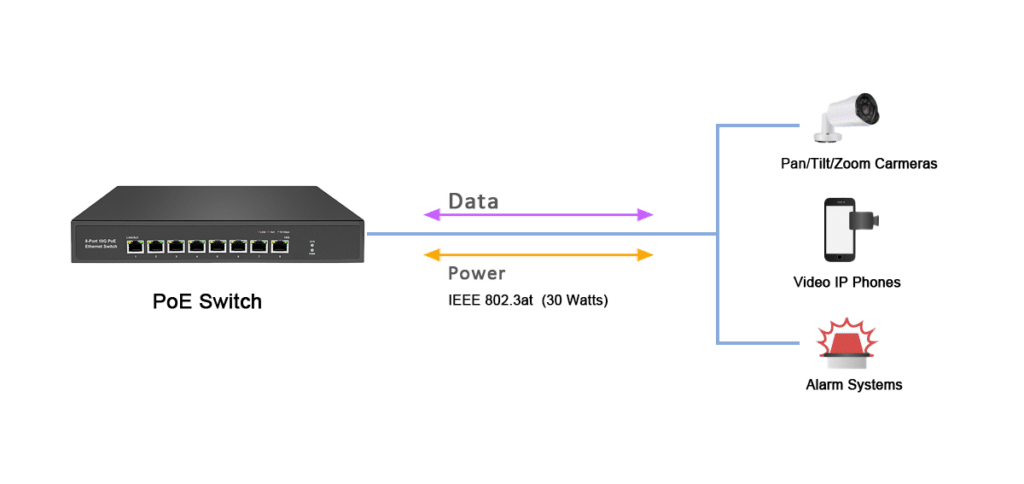
PoE+, also called IEEE 802.3at, was introduced in 2009 to support devices requiring higher power consumption.
A PoE+ switch can supply up to 30W per port, while powered devices can receive up to 25.5W.
Like standard PoE, PoE+ still uses two twisted pairs for power delivery, but it significantly increases available power capacity.
Typical PoE+ Applications
PoE+ switches are widely used for:
- PTZ IP cameras
- WiFi 5 and WiFi 6 access points
- Video IP phones
- Biometric access control systems
- Advanced surveillance equipment
PoE+ has become one of the most popular standards for enterprise networking and modern surveillance deployments.
What Is PoE++ (IEEE 802.3bt)?
PoE++, based on the IEEE 802.3bt standard, is the latest and most powerful PoE standard currently available.
PoE++ supports two power types:
- Type 3 PoE++: up to 60W per port
- Type 4 PoE++: up to 90W or 100W per port
Unlike PoE and PoE+, PoE++ uses all four twisted pairs in the Ethernet cable to deliver significantly higher power.
Typical PoE++ Applications
PoE++ switches are ideal for high-power applications including:
- WiFi 6E and WiFi 7 access points
- High-performance PTZ cameras
- Industrial automation systems
- LED lighting systems
- Thin clients
- Smart building controllers
- Digital signage
- Video conferencing systems
- PoE-powered monitors and laptops
As enterprise and industrial networks continue to evolve, PoE++ switches are increasingly becoming the preferred choice for future-proof network infrastructure.

PoE vs PoE+ vs PoE++ Comparison Table
| Feature | PoE | PoE+ | PoE++ Type 3 | PoE++ Type 4 |
|---|---|---|---|---|
| IEEE Standard | 802.3af | 802.3at | 802.3bt | 802.3bt |
| PoE Type | Type 1 | Type 2 | Type 3 | Type 4 |
| Max Power Per Port | 15.4W | 30W | 60W | 90W–100W |
| Power Available to Device | 12.95W | 25.5W | 51W | 71W |
| Cable Pairs Used | 2-pair | 2-pair | 4-pair | 4-pair |
| Supported Cable | Cat3 or higher | Cat5 or higher | Cat5e/Cat6 | Cat5e/Cat6 |
| Common Applications | VoIP phones | WiFi APs | PTZ cameras | Smart buildings |
How to Choose the Right PoE Switch?
Choosing the right PoE switch depends on several factors, including device power requirements, network size, future expansion, and application scenarios.
Choose PoE Switches for Basic Devices
If your network mainly includes low-power devices such as:
- Basic IP cameras
- VoIP phones
- Sensors
- Simple access control systems
then a standard PoE switch is usually sufficient.
PoE switches are cost-effective and suitable for small office networks and entry-level surveillance systems.
Choose PoE+ Switches for Enterprise Networks
PoE+ switches are recommended when deploying devices with higher power requirements, such as:
- WiFi 6 wireless access points
- PTZ security cameras
- Video conferencing phones
- Advanced access control systems
For most enterprise environments, PoE+ offers the ideal balance between performance, scalability, and cost.
Choose PoE++ Switches for High-Power Applications
PoE++ switches are designed for modern high-performance network environments.
You should consider PoE++ switches if your deployment includes:
- WiFi 6E or WiFi 7 access points
- Multi-gigabit wireless infrastructure
- Industrial automation equipment
- Smart LED lighting systems
- High-power PTZ cameras
- Digital signage
- Thin clients and mini PCs
PoE++ also provides better long-term scalability for future network upgrades.
Industrial PoE Switch vs Commercial PoE Switch
Industrial PoE switches are specifically designed for harsh environments such as factories, transportation systems, mining, and outdoor deployments.
Compared with commercial PoE switches, industrial PoE switches typically offer:
- Wider operating temperature ranges
- DIN-rail mounting
- Redundant power inputs
- Surge and EMI protection
- Rugged metal housing
- Enhanced reliability
Industrial PoE++ switches are increasingly used in:
- Smart transportation
- Factory automation
- Intelligent surveillance
- Energy systems
- Outdoor wireless networks
For mission-critical applications, industrial managed PoE switches provide better stability and network control.
Is PoE++ Backward Compatible?
Yes. PoE++ is backward compatible with both PoE and PoE+ devices.
A PoE++ switch can safely power:
- PoE devices
- PoE+ devices
- PoE++ devices
The switch automatically detects the required power level of the connected device and supplies appropriate power accordingly.
This backward compatibility makes PoE++ an excellent choice for future-proof network infrastructure.
What Cable Should You Use for PoE++?
For standard PoE and PoE+, Cat5e cables are usually sufficient.
However, for PoE++ deployments, especially high-power Type 4 applications, Cat6 or Cat6a cables are recommended because they offer:
- Better heat dissipation
- Lower power loss
- Higher bandwidth
- Improved reliability
Using high-quality Ethernet cables becomes increasingly important in long-distance and high-power PoE deployments.
Future Trends of PoE Technology
As networking technology evolves, PoE continues to expand into new applications.
Some major PoE trends include:
- Multi-Gig PoE switches
- 2.5G and 10G PoE++
- WiFi 7 infrastructure
- Smart building automation
- Industrial IoT networking
- AI surveillance systems
- Unified power and data infrastructure
PoE++ technology is expected to play an increasingly important role in next-generation enterprise and industrial networks.
FAQ
PoE provides up to 15.4W per port, while PoE+ supports up to 30W per port for higher-power devices.
PoE+ delivers up to 30W per port using two cable pairs, while PoE++ supports up to 90W or 100W using all four cable pairs.
Yes. Cat5e can support PoE++, but Cat6 or Cat6a cables are recommended for better performance and heat management.
Standard PoE cannot power laptops. However, PoE++ Type 4 can provide enough power for certain compact laptops and thin clients.
Yes. PoE++ is ideal for high-power devices and future-proof network deployments, especially for WiFi 6/7, industrial IoT, and smart building applications.
The standard maximum transmission distance for PoE, PoE+, and PoE++ is 100 meters (328 feet) over Ethernet cable.
Conclusion
PoE, PoE+, and PoE++ switches each serve different networking requirements based on power delivery, device compatibility, and application scenarios.
Standard PoE switches are suitable for basic network devices such as VoIP phones and standard IP cameras. PoE+ switches provide higher power for enterprise wireless access points and PTZ surveillance systems. For high-power applications including WiFi 6E, industrial automation, and smart buildings, PoE++ switches offer the best performance and scalability.
When selecting a PoE switch, it is important to evaluate your current device requirements, future expansion plans, total power budget, and network infrastructure.
E-link provides a complete range of unmanaged, managed, industrial, and multi-gig PoE switches designed for enterprise, surveillance, transportation, and industrial networking applications.