

In many real network deployments, especially surveillance and wireless setups, power is often the limiting factor rather than data.
You can place cameras or access points exactly where they are needed, but getting power to those locations is not always convenient. Running new electrical lines is expensive and sometimes simply not realistic.
That’s usually where a PoE injector comes into the picture.
It is not a new or complex technology. In fact, it’s a very simple idea that continues to stay relevant because it solves a very practical problem.
what is a poe power injector
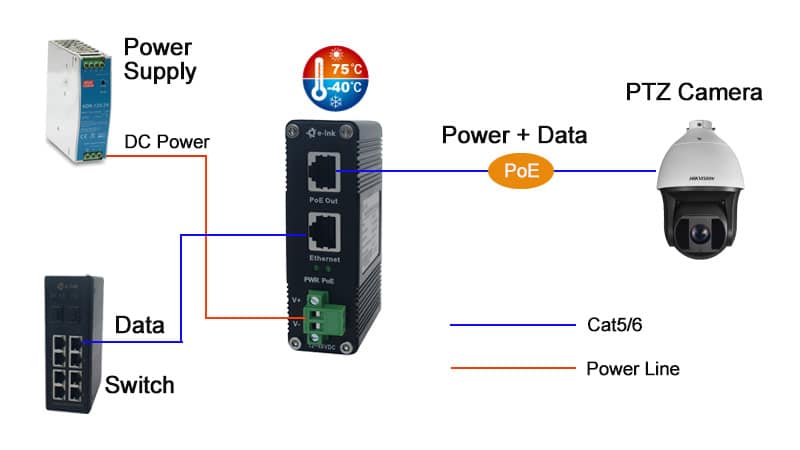
A PoE injector takes a normal Ethernet connection and adds electrical power into it.
So instead of running two separate things:
- one cable for data
- one power adapter at the device
You combine both into a single Ethernet cable.
Nothing fancy. No configuration in most cases. Just inline hardware doing a specific job.
This is also why it is often used in small upgrades rather than full network redesigns.
Why it still exists in modern networks
You might think PoE switches have replaced this kind of device completely.
In large deployments, yes, PoE switches are more efficient.
But in real-world installations, things are not always planned from the beginning.
A few common situations:
- A system is already installed, and one more camera is added later
- A WiFi access point needs to be moved, but no power is available in that new location
- A small office setup doesn’t justify replacing the entire switch
In these cases, changing infrastructure just for one or two devices is overkill.
So instead, power is simply injected at one point in the line.
Basic working principle
The setup is usually very straightforward:
You have:
- a network switch or router
- an injector unit
- a powered device (camera, AP, etc.)
The injector sits between the network side and the device side.
It receives:
- data from the switch
- power from an external adapter
Then it outputs both through a single Ethernet cable.
No software, no configuration in most cases. It just works at hardware level.
PoE switch vs injector
In practice, choosing between a PoE switch and a PoE injector is less about theory and more about how the network is built or expanded.
| Aspect | PoE Switch | PoE Injector |
|---|---|---|
| Deployment Type | Best for new or large-scale network setups | Ideal for small upgrades or existing networks |
| Installation | May require replacing current switch | Simply added inline, no major changes |
| Cost | Higher upfront investment | Lower cost for single or few devices |
| Flexibility | Centralized solution for multiple devices | Targeted solution for individual devices |
| Scalability | Suitable for expanding networks | Limited to specific endpoints |
| Typical Use Case | Building a structured network from scratch | Adding power to one or two devices |
In Real Deployments
- PoE switches are typically used when building a network from the ground up
- PoE injectors are more common when modifying or expanding an existing setup
Both approaches are valid — they simply address different stages of network deployment.
Power levels: 30W vs 90W explained
Not all devices consume the same amount of power, and this is where most confusion happens.

30W (PoE+ / IEEE 802.3at)
This is the most commonly used range.
It is enough for:
- standard IP cameras
- typical wireless access points
- VoIP phones
In most small office or home setups, this level is already sufficient.
There is no need to go higher unless the device requires it.

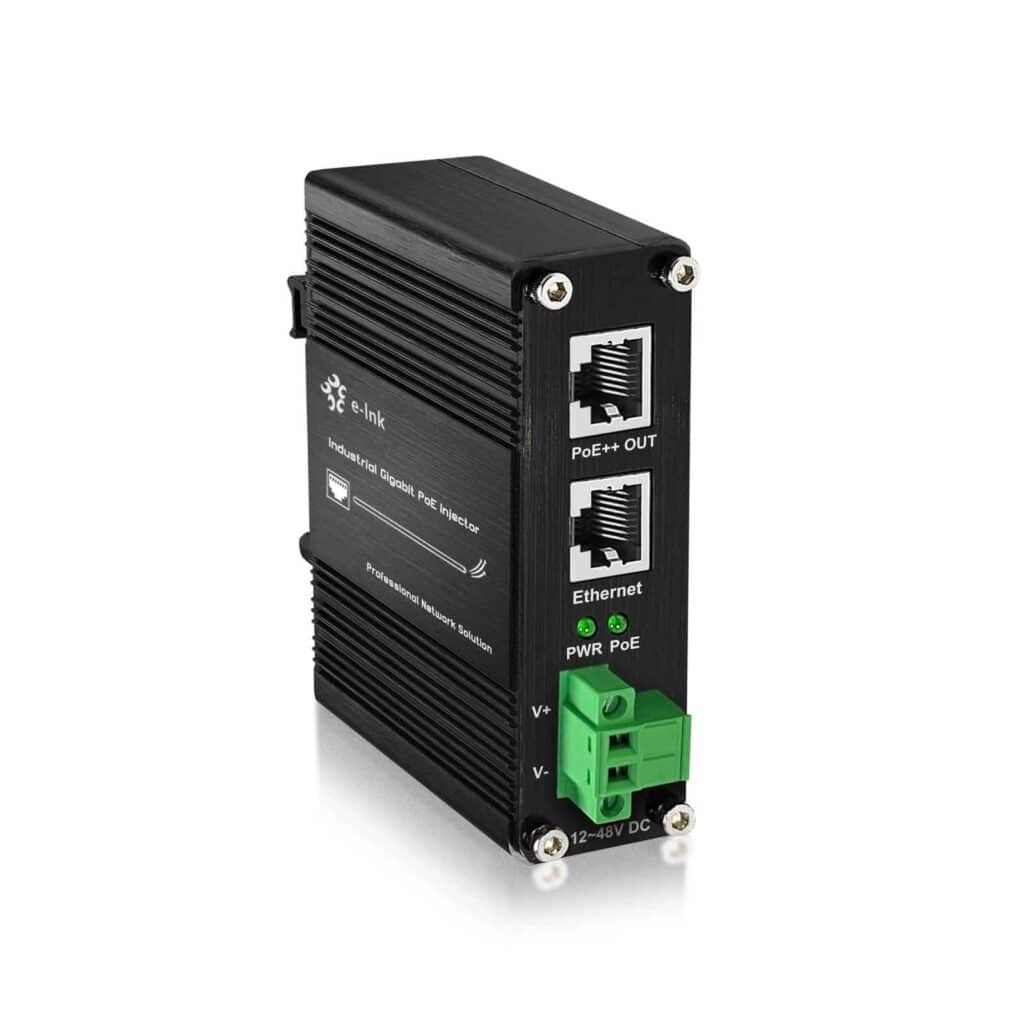
90W (PoE++ / IEEE 802.3bt)
This is the higher power category.
It is used when devices demand significantly more energy.
Typical use cases include:
- PTZ cameras with motors and zoom functions
- WiFi 6 / WiFi 7 access points
- industrial networking devices
- smart building systems like lighting control
In simple terms, this is for equipment that does more than just basic data transmission.
Choosing between them
There is no universal answer here, but in practice:
- 30W is enough for most standard deployments
- 90W is used when power demand is higher or future upgrades are expected
Some installers prefer higher power even if it is not strictly needed, just to avoid limitations later.
Where this setup is commonly found
You will usually see PoE-based power delivery in:
- CCTV surveillance systems
- office wireless network expansions
- outdoor monitoring setups
- small industrial installations
A typical example is a security camera installed on a wall or pole, where running a separate power line would be inefficient or expensive.
One Ethernet cable becomes the simplest solution.

Practical considerations before choosing
Before selecting a unit, installers usually check a few basic points:
- power requirement of the device
- whether Gigabit speed is needed
- IEEE standard compatibility (802.3af / at / bt)
- installation environment (indoor vs outdoor)
These factors usually matter more than brand or marketing terms.
Final thoughts
A PoE injector is not meant to replace a full network design.
It is more of a practical tool used when changes need to be made without rebuilding the system.
That is also why it is still widely used today, even with more advanced PoE switches available.
In most cases, 30W solutions are sufficient for standard devices, while 90W options are reserved for higher power requirements or future-proof installations.
The decision usually comes down to how the network is built, not just what the specifications say.