
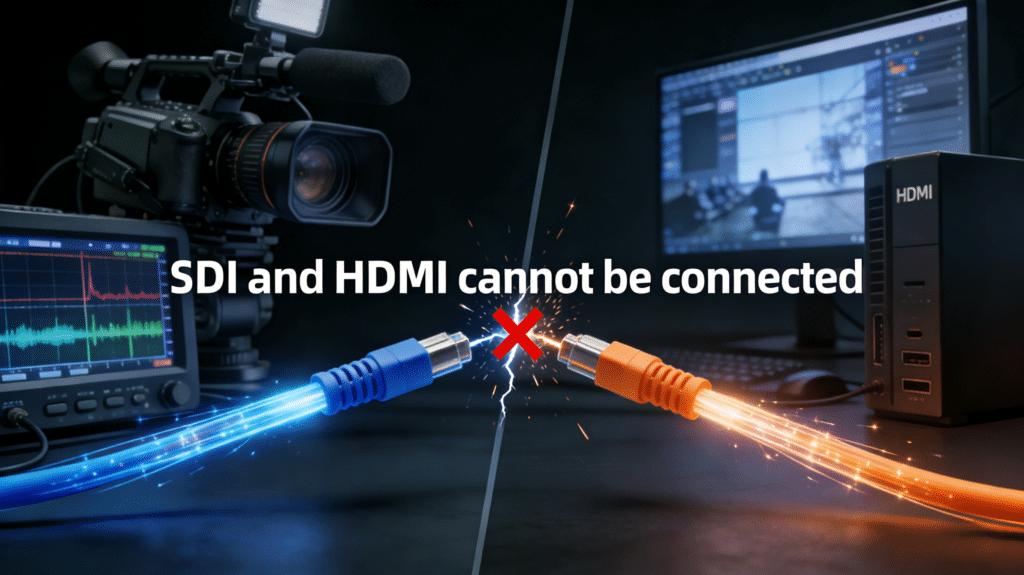
When designing a long-distance video transmission system, a common question arises:
Can an SDI fiber converter work with an HDMI fiber converter?
The short answer is no — they are not directly compatible.
Understanding the reason behind this helps you design a more reliable and scalable system.
SDI vs HDMI: Understanding the Difference
Before discussing fiber transmission, it’s important to understand the signal types.

SDI (Serial Digital Interface)
- Used in broadcast and surveillance systems
- Supports uncompressed video
- Stable over long distances
- Based on SMPTE standards
Typical device: → LNK-MHD
HDMI (High-Definition Multimedia Interface)
- Used in AV and commercial display systems
- Carries video, audio, and control signals (EDID, HDCP)
- More complex signal structure
Typical device: → LNK-HF100DA
Why SDI Fiber and HDMI Fiber Are Not Compatible

1. Different Signal Formats
Although both systems use fiber optic cables, the transmitted data is fundamentally different:
- SDI → continuous serial digital stream
- HDMI → encoded digital signal with handshake and control
Result:
An HDMI receiver cannot decode an SDI signal, and vice versa.
2. No Universal Fiber Protocol
Fiber is only a transmission medium — not a standardized protocol.
Each converter uses:
- Proprietary encoding
- Clock recovery mechanisms
- Optical transmission logic
This means:
- SDI fiber transmitter must pair with SDI receiver
- HDMI fiber transmitter must pair with HDMI receiver
Cross-connection will not work.
3. Protocol-Level Differences
HDMI includes:
- EDID negotiation
- HDCP encryption
- Embedded audio
SDI:
- No handshake
- Continuous signal transmission
- Broadcast-grade timing
These differences make direct compatibility impossible.
What Actually Works
Instead of mixing incompatible devices, use one of the following proven system designs.
Solution 1: SDI Fiber + HDMI Conversion
Best for: long-distance transmission (up to 80km), broadcast and surveillance
Topology:
SDI Camera
→ SDI Fiber Transmitter (LNK-MHD)
→ Fiber
→ SDI Fiber Receiver
→ SDI to HDMI Converter
→ HDMI Display
Advantages:
- Longest transmission distance
- High stability
- Uncompressed signal

LNK-MHD → Professional HD-SDI Fiber Converter 1080P with 80km
Solution 2: Convert to HDMI Before Fiber
Best for: AV systems, meeting rooms, commercial displays
Topology:
SDI Camera
→ SDI to HDMI Converter
→ HDMI Fiber Transmitter
→ Fiber
→ HDMI Fiber Receiver (LNK-HF100DA)
→ Display
Advantages:
- Simpler system design
- Native HDMI output
- Better display compatibility

LNK-HF100DA → Professional 1080P HDMI Fiber Converter with Bidirectional Audio RS232 20km

Common Mistake
A frequent misunderstanding is:
“If both devices use fiber, they should work together.”
This is incorrect.
Compatibility depends on:
- Signal type
- Encoding method
- Device pairing
—not just the cable type.
When Can Mixed Systems Work?
Mixed systems only work when devices support standardized protocols such as:
- SMPTE 2110 (IP-based video)
- Other unified transport standards
Standard SDI and HDMI fiber converters do not support these protocols.
How to Choose the Right Solution
When planning your system, consider:
1. Source Type
- SDI → stay SDI or convert early
2. Output Interface
- HDMI display → plan where conversion happens
3. Transmission Distance
- 20km → SDI fiber preferred
- Short to medium distance → HDMI fiber is sufficient
Final Verdict
- SDI fiber and HDMI fiber converters are not compatible
- Transmitters and receivers must be paired by signal type
- Signal conversion is required when mixing formats
Need Help?
If you’re unsure about your setup, provide:
- Source device (SDI or HDMI)
- Display type
- Required distance
A properly designed system will reduce installation time, avoid compatibility issues, and improve long-term reliability.
Frequently Asked Questions (FAQ)
No, you cannot connect an SDI fiber transmitter (such as LNK-MHD) directly to an HDMI fiber receiver (like LNK-HF100DA).
They use different signal formats, and the receiver will not recognize the incoming data.
Because they use completely different transmission protocols:
- SDI is a continuous broadcast signal
- HDMI includes encoding, EDID, and HDCP
Even over fiber, the data structures are incompatible.
There are two reliable methods:
- Use SDI fiber transmission, then convert SDI to HDMI at the receiver side
- Convert SDI to HDMI first, then use an HDMI fiber system
Both methods are widely used in real installations.
Yes, fiber can carry both types of signals, but not at the same time using the same converter.
You must use:
- SDI-compatible devices for SDI signals
- HDMI-compatible devices for HDMI signals
- For ultra-long distance (up to 80km) → SDI fiber systems
- For AV and display systems → HDMI fiber solutions
Choosing depends on your source and display type.
Yes, if your source is SDI and your display is HDMI, you must use an SDI to HDMI converter at some point in the system.