

Introduction
A network card, also called a Network Interface Card (NIC), is a hardware part. It lets computers, servers, and industrial devices connect to a network. It connects a device to the network by sending data through Ethernet cables, fiber optic cables, or wireless signals.
Although wireless connectivity has become common in consumer electronics, wired Ethernet solutions remain the foundation of enterprise networking. Businesses, data centers, and industrial systems still rely on Ethernet adapters. They offer stable connections, steady performance, and long-term reliability.
Today, network interfaces are available in different forms, including RJ45 Ethernet adapters, fiber NICs with SFP or SC interfaces, and high-performance server adapters. The right choice depends mainly on transmission speed, communication distance, and the environment where the equipment operates.
How Does a Network Card Work?
A network card works as the communication interface between a computing device and the network. When a computer sends data, the NIC processes the information, converts it into Ethernet frames, and transfers the signal through the selected transmission medium.
For traditional Ethernet connections, the adapter sends electrical signals through copper cables such as Cat5e or Cat6. For fiber-based networks, the NIC converts electrical data into optical signals and sends them through fiber optic cables, allowing communication over much longer distances.
Modern NIC solutions provide more than basic data transmission. Advanced adapters support technologies such as VLAN, Quality of Service (QoS), flow control, Jumbo Frames, and TCP/IP checksum offloading. These features improve network efficiency and reduce processing pressure on servers, making them especially valuable in enterprise and data center environments.

Common Types of Network Cards
Different network environments require different connectivity solutions. The most common types include Ethernet NICs, fiber NICs, and wireless adapters.
| Type | Interface | Common Applications |
|---|---|---|
| Ethernet NIC | RJ45 copper port | Desktop PCs, offices, enterprise LAN |
| Fiber NIC | SFP or SC fiber port | Servers, data centers, backbone networks |
| Wireless Adapter | Wi-Fi interface | Laptops and mobile devices |
| Industrial Network Adapter | Fiber/Ethernet interface | Factory automation and control systems |
Among these options, Ethernet-based adapters remain the most widely deployed. However, fiber NIC solutions play a critical role in professional networks where standard copper connections cannot meet distance or performance requirements.
SFP Fiber NIC: Flexible Connectivity for Servers and Data Centers
Among fiber solutions, SFP-based NICs have become one of the most popular choices for modern network infrastructure.
An SFP fiber NIC uses a removable optical module, allowing network engineers to select different transceivers according to fiber type, distance, and application requirements. This flexibility makes SFP interfaces easier to upgrade compared with fixed optical connectors.
For example, the E-link LNK-LC1000-SFP provides a Gigabit fiber connectivity solution for servers, enterprise networks, and data center applications.
The LNK-LC1000-SFP Series supports IEEE 802.3z Gigabit Ethernet standards and provides 1000Mbps fiber transmission through an SFP interface. It supports both single-mode and multimode fiber connections and provides advanced networking features including VLAN management, QoS support, and full-duplex operation.
With its PCI Express interface and flexible optical module design, this type of adapter helps organizations build scalable fiber networks while maintaining compatibility with different optical environments.

SC Fiber NIC: Stable Fiber Connection for Long-Distance Applications
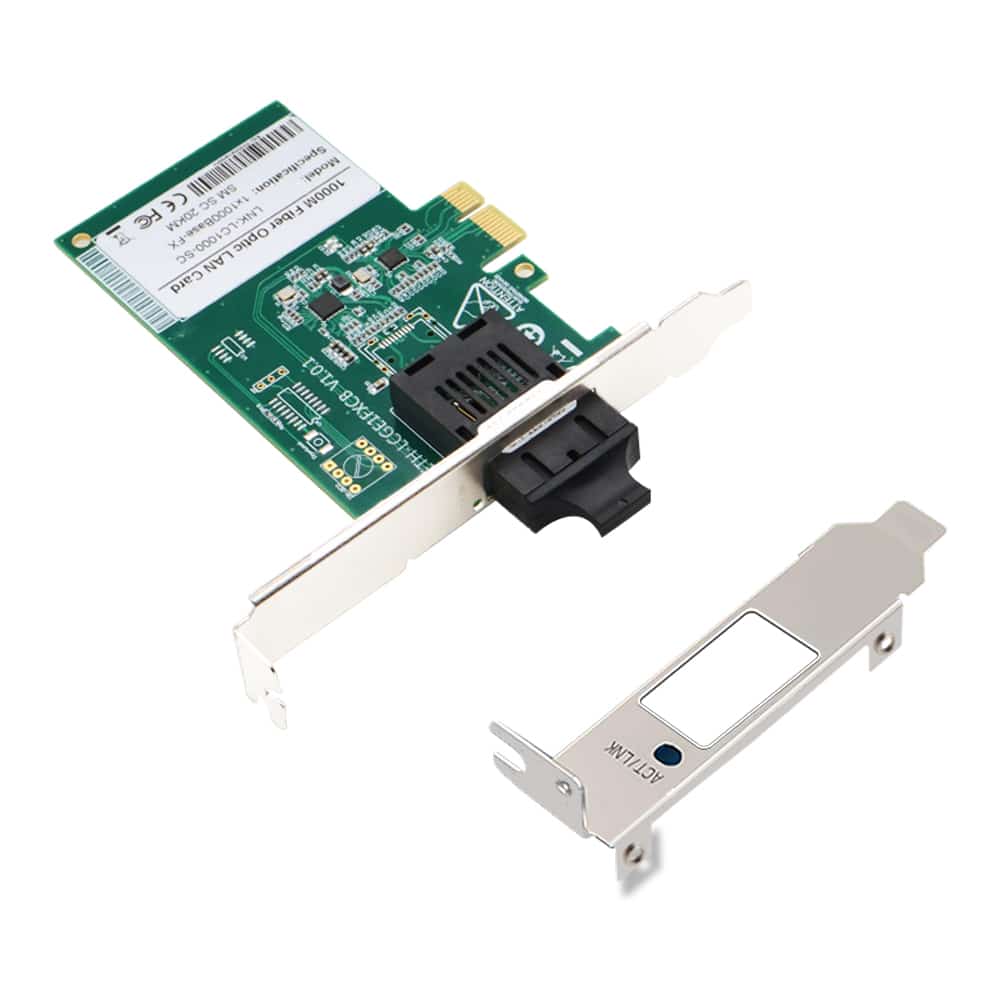
While SFP interfaces focus on flexibility, SC fiber NICs provide a simple and stable solution for fixed fiber connections.
SC connectors are widely used in industrial communication, security systems, campus networks, and telecommunications applications because they provide a reliable physical connection and support long-distance fiber transmission.
Compared with copper Ethernet connections, SC fiber solutions offer better resistance to electromagnetic interference and are suitable for environments where consistent communication is required.
For projects that prioritize connection stability and straightforward deployment, SC fiber adapters remain an effective choice.
How to Select the Right Network Interface?
Choosing the correct NIC requires evaluating several factors, including network speed, transmission distance, interface type, and system compatibility.
The first consideration is speed. Gigabit adapters are suitable for most office networks and standard server connections, while higher-speed solutions are better suited for data centers and applications with heavy data traffic.
The second factor is the physical interface. RJ45 adapters are suitable for copper Ethernet networks, while SFP and SC fiber interfaces provide better solutions for long-distance and professional networking environments.
Transmission distance is another important consideration. Copper Ethernet works well for short connections, but fiber technology can extend communication over hundreds of meters or several kilometers depending on the fiber type and optical module.
Finally, users should confirm compatibility with the target system, including PCIe slot requirements, operating system support, and driver availability.
Conclusion
A network card is a key component that connects devices to modern communication networks. While RJ45 Ethernet adapters remain the most commonly used solution for everyday networking, fiber NIC technologies have become increasingly important in professional environments.
For servers, data centers, and enterprise networks, SFP fiber NICs provide flexibility and scalability through interchangeable optical modules. For industrial systems and long-distance fiber communication, SC fiber solutions offer stable and reliable connectivity.
By understanding the differences between Ethernet adapters, fiber NICs, SFP interfaces, and SC interfaces, network engineers can select the most suitable solution based on performance requirements, network design, and future expansion needs.